
LEGO Fabuland: History, Figures and Sets of the Cult Series (1979–1989)
You know that feeling? You're clearing out the attic and suddenly find a box with a little elephant sitting in it, wearing a red hat. No name on the packaging anymore, no instructions, but somehow the face looks familiar. That's Edward. And that's LEGO Fabuland.
From 1979 to 1989, foxes, elephants, bears and crocodiles populated a brightly coloured little town. For ten years. Then it was over, no big finale, no farewell tour. The sets hit the shelves and after that, nothing.
Today Fabuland is a cult classic. Highly sought after by collectors, hidden away in modern LEGO sets, and when you open LEGO Animal Crossing, you think for a second: Wait, I know this from somewhere.
You do. That's Fabuland. 35 years later, with a Nintendo licence.
Here's everything you need to know about this underrated LEGO legend.
Table of Contents
- What exactly is LEGO Fabuland?
- How it came about
- The residents of Fabuland
- Sets, buildings and vehicles
- The parts that survived to this day
- The Fabuland colours
- From audio plays to TV series
- Fabuland from 1979 to today
- Fabuland and Animal Crossing
- What Fabuland is worth today
- Frequently asked questions
What exactly is LEGO Fabuland?
Simply put: a LEGO series for younger children, produced from 1979 to 1989. The target audience was children between roughly 3 and 7 years old. The figures had animal heads on a body that looked a lot like the classic minifigure. Movable arms, movable legs, rotating head. A deluxe minifigure package in a fur costume, if you will.
Fabuland was the first LEGO series with named characters and its own stories. That sounds obvious today, but back then it was a genuine innovation. The LEGO City police officer did his job anonymously. You knew the Fabuland police officer personally.
Fabuland was also the first LEGO series for which other companies received licences. Books, audio plays, memory games, keychains, clothing, children's cutlery, a TV series. What we call merchandise today started at LEGO with Fabuland.
How it came about
DUPLO had been around since 1969. Huge bricks, no choking hazard, perfect for toddlers. The classic LEGO system, meanwhile, was getting more and more complex and fiddly. There was a gap in between. Children who had long outgrown DUPLO but weren't ready for the small LEGO bricks yet.
Fabuland was meant to be exactly that bridge. Bigger than regular LEGO parts, smaller than DUPLO parts. Quick to build, easy to play with, yet fully compatible with the standard LEGO system. The 1979 catalogue described it as: "A new little world. Easy to build, fantastic to play with."
And it worked. Fabuland was a genuine success.
The residents of Fabuland
BrickLink lists a total of 98 Fabuland figures. Anyone who knows all of them either has a very good childhood memory or has spent too much time on BrickLink. Both are completely understandable.
Each figure had a name and a job in the Fabuland community. Quick note: the names varied by country, often quite significantly. In German, alliteration was common. In English, the names were equally fun. Some of the best-known and verified characters:
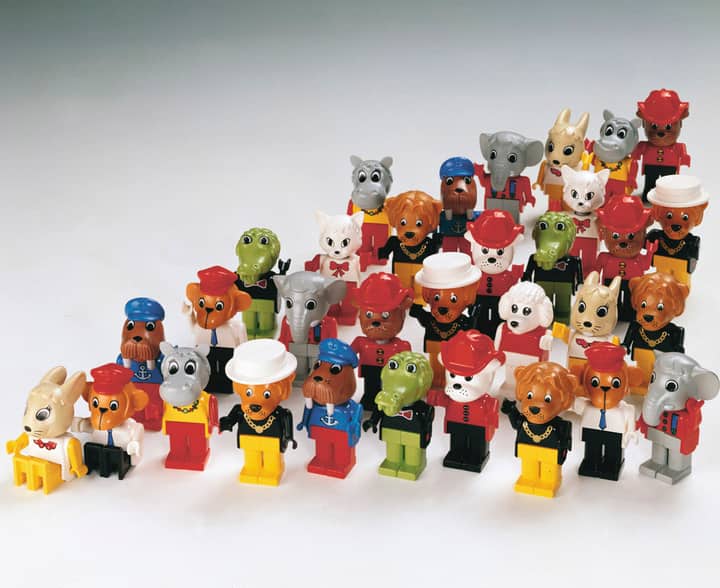
- Edward Elephant - the unofficial hero of the series
- Lionel Lion
- Bruno Bear
- Freddy Fox
- Boris Bulldog - the postman
- Bonnie Bunny
- Mortimer Mouse
- Paul Parrot
The four characters in the 2025 LEGO House Tribute Set are Edward Elephant, Joe Crow, Dr. Lucy Lamb and Clive Crocodile.
The early figures from 1979 had simple printed faces with white dot eyes. From 1986 onwards, characters got prints on their torsos for jewellery, dungarees and other details, and their eyes gained irises and pupils. Some wore helmets or hats that could partially be removed.
Sets, buildings and vehicles
Around 100 sets in ten years. From tiny single figures with accessories to large building sets, everything was covered. Set numbers were three digits at first, from 1980 onwards uniformly in the 3600 and 3700 number ranges.
Single figures with accessories
The smallest sets: one figure, one accessory. The baker with a baguette, the fisherman with a net, the doctor with a bag. Affordable, collectible, and of course you always needed just one more.
Buildings
Fire station, police station, hospital, post office, harbour, family homes. The interiors were large enough to play with the figures inside. The biggest set was the fire station 3682 with 149 pieces, all of them suitably chunky.
The buildings evolved over the years. Until 1981 there were still large prefabricated wall elements with built-in doors. From 1982, these were replaced by smaller individual elements and new roof pieces with chimneys and antennas. The cardboard boxes for figures were also replaced by blister packs. Fabuland developed over time. You can see it in the sets.
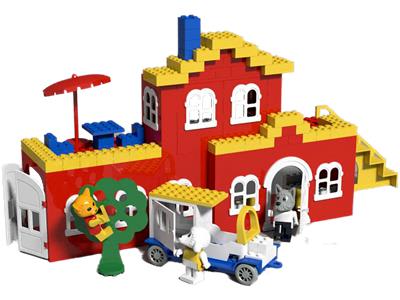
Vehicles and fairground
Cars, taxis, delivery vans, fire engines, police cars, boats, motorcycles. And because that wasn't enough, there were also fairground sets with carousels and swings, like the 3683 Amusement Park. A complete Fabuland village wasn't just a town, it was also a theme park. Pretty cool world, actually.
Instructions you could read aloud
The special thing about the larger sets: the building instructions were also a story. Kids could watch their figures build the same thing they were building. Colourful pictures, text for parents to read aloud, little speech bubbles from the characters. Interactive storytelling from 1979. LEGO hasn't really topped that since.
The parts that survived to this day
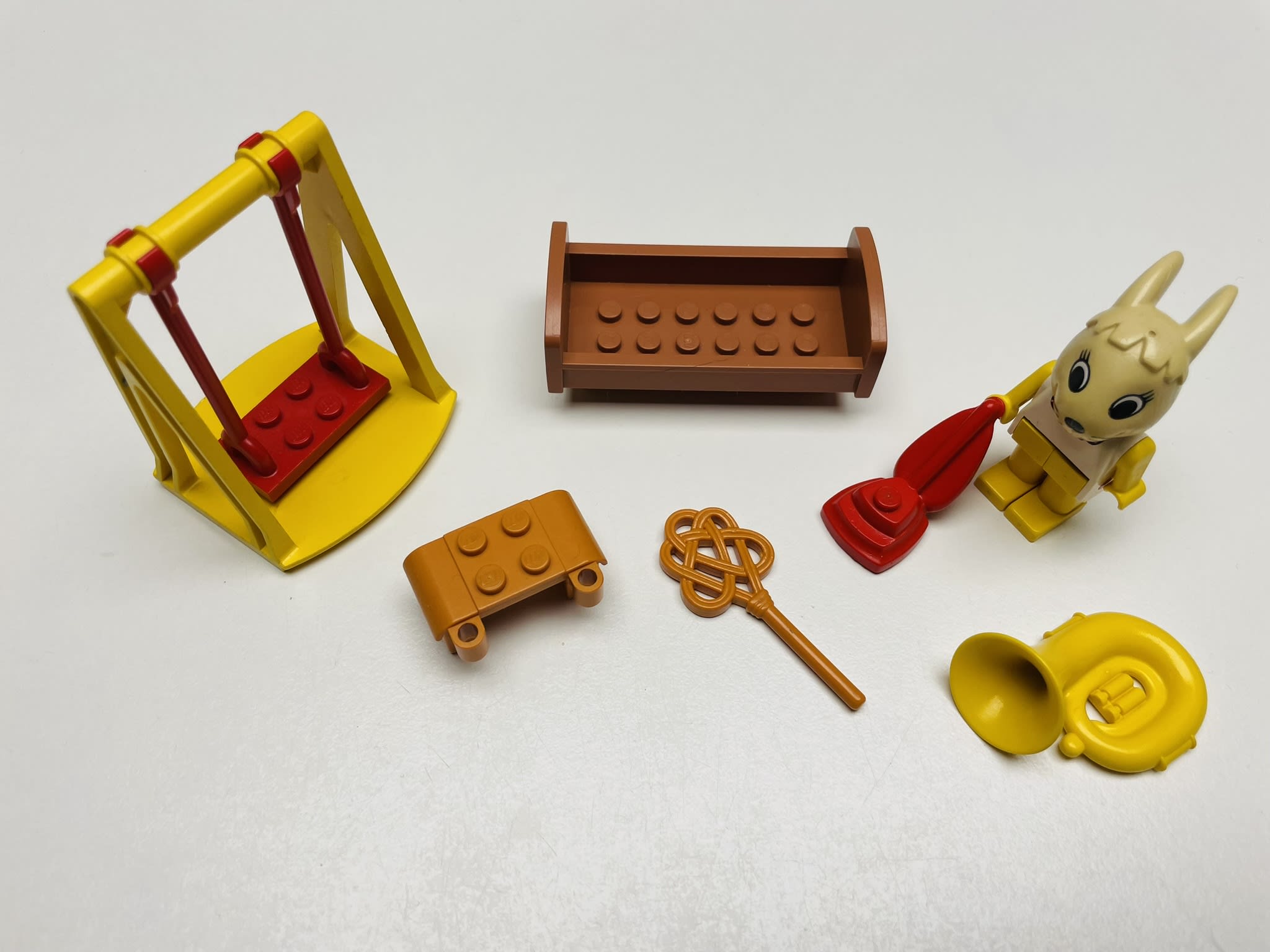
BrickLink lists 238 parts in the Fabuland category. Many of them are still active in the LEGO system today, often without anyone knowing where they came from. Quick note for anyone who thinks these are newer parts:
- The broom: Used to sweep streets in Fabuland. In 2001 Harry Potter flew it to his first Quidditch match.
- The steering wheel: Already on board before the LEGO Pirates set sail in 1989.
- The water trough: A Fabuland original, still used in sets today in a slightly modified form.
- The baguette: Invented in the Fabuland bakery. Still fresh in the LEGO range in 2026.
- The cauldron: This is the most curious case. The part originated in Fabuland and was originally produced with the Fabuland logo in the mould. The logo was eventually scratched out, the part stayed. At LEGO Pick a Brick it is still named after its Fabuland origins.
The Fabuland colours
Fabuland was colourful, but in a very specific way. Red, yellow and blue dominated. Black and white, standard in other LEGO themes of the late 70s, barely appeared in Fabuland. Transparent colours didn't exist at all.
Instead, Fabuland introduced three special colours to represent wooden surfaces, which can still cause confusion among BrickLink sellers today:
- Fabuland Brown - tables and chairs
- Fabuland Orange - fences and water trough
- Earth Orange - including the iconic carpet beater and paintbrush
Fabuland Orange looks confusingly similar to today's Medium Nougat. But they're different colours. Fair to say: that has already led to a few BrickLink orders that didn't quite look as expected when they arrived.
From audio plays to TV series
Time for a trip back in time. As early as 1979, the first German Fabuland audio play was released on vinyl, "Stories from Fabuland", written by Sebastian Beck and produced by Michael Weckler at Phonogram Inc. Later came cassettes. The theme tune was the soundtrack to building for many kids in the 80s.
In 1986, FilmFair Productions from the UK produced the stop-motion series Edward and Friends. Claymation, 19 episodes, five minutes each. Broadcast from 1987 to 1989 in the UK, Canada and New Zealand. Every episode with a small message about tolerance or helping others. Short, but good. All episodes were released on VHS and can still be found on YouTube today. Seven tie-in books were also published using stills from the show. The merchandise model that LEGO uses today with Ninjago, City and all other themes started with Fabuland. The cassettes just aren't quite as relevant anymore. Everything else still is.
Want to see every single Fabuland set at once? BrickTsar built all of them in 2024 and documented the whole thing. Pretty impressive what came out of ten years of Fabuland.


Fabuland from 1979 to today
- 1979: Fabuland launches. First sets, first German audio play on vinyl. LEGO thinks beyond the toy from day one.
- 1982: Redesign. New roof elements, new building construction, blister packs instead of cardboard boxes. Fabuland gets rounder and more recognisable.
- 1986: New generation of figures with torso prints and more detailed eyes. FilmFair Productions produces the TV series "Edward and Friends".
- 1987 to 1989: "Edward and Friends" airs in the UK, Canada and New Zealand. All 19 episodes are released on VHS.
- 1989: Fabuland is discontinued. No finale, no farewell series. The Fabuland area at LEGOLAND Billund is converted into a DUPLO area.
- 2014: Fabu-Fan appears in The LEGO Movie, a minifigure who is a self-confessed Fabuland fan. The community is delighted.
- 2022: The anniversary set 11021 "90 Years of Play" includes a modern reinterpretation of the Fabuland elephant.
- 2024: A Fabuland poster is hidden in the LEGO Ninjago City Workshops (71837). Finding it makes you part of the elite.
- 2025: LEGO House exclusive Tribute Set 40506. Edward Elephant, Joe Crow, Dr. Lucy Lamb and Clive Crocodile return as brick-built figures in a modern reinterpretation. Only available at the LEGO House in Billund. A dedicated Fabuland exhibition runs alongside the release.
Fabuland and Animal Crossing: what do they have in common?
When LEGO Animal Crossing arrived in 2024, Fabuland fans weren't surprised. The parallels are obvious.
Both show a peaceful world of anthropomorphic animals with their own names and personalities. No villain, no conflict as a game mechanic, just a wholesome little community. Houses get decorated, neighbours get visited, life gets enjoyed. That's Fabuland. That's Animal Crossing.
Cut to 35 years later.
Fair to say though: Fabuland was a standalone LEGO universe with its own lore and history. Animal Crossing is a Nintendo licence built on decades of fan loyalty to the game series. Fabuland was clearly aimed at toddlers, Animal Crossing speaks just as much to adult Nintendo fans as to kids from age 6. Not the same thing, but the core feeling? Identical.
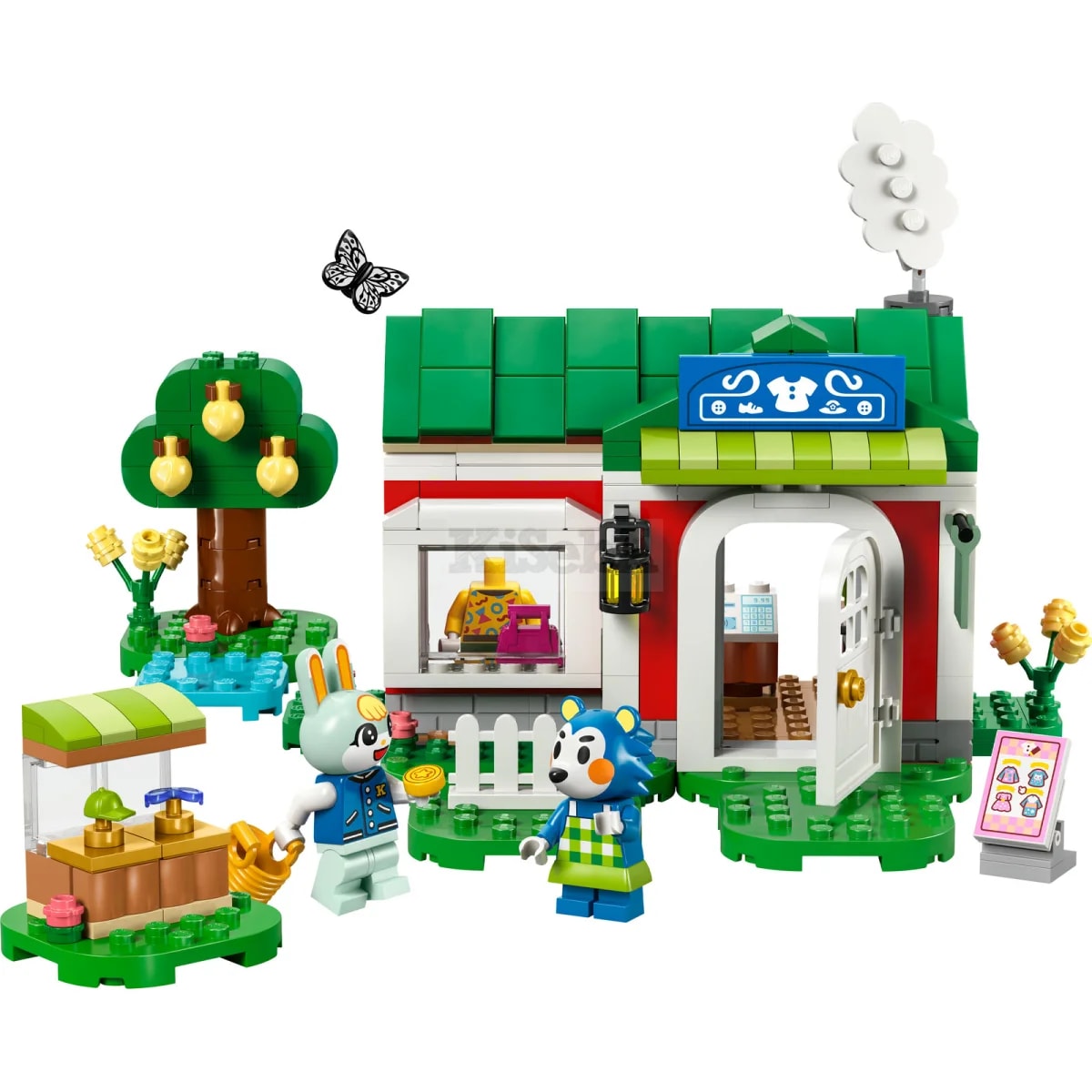
If this has sparked your interest: check out our LEGO Animal Crossing range right here.
What Fabuland is worth today
Fabuland is still hot among collectors, for three reasons.
First, the parts are unique. The animal heads of the figures were developed exclusively for this series and were never reproduced afterwards. No other LEGO set in history has reused these heads. That makes them rare and highly sought after by MOC builders.
Second, the nostalgia factor is real. Anyone who was a child in the 80s is now in their late 40s or early 50s, with the budget to match and a good memory. The market for classic 80s LEGO is booming, and Fabuland is one of the gems of that market.
Third, LEGO itself keeps the memory alive. The LEGO Movie cameo, the 90th anniversary set, the 2025 Tribute Set, the Ninjago Easter egg. Fabuland isn't forgotten. It's in the system.
What does it cost today? Complete, factory-sealed sets can reach several hundred euros on BrickLink and eBay depending on rarity. Individual figures with accessories go for 20 to 60 euros. So if you've still got a box full of Fabuland in the attic: congratulations.
Frequently asked questions about LEGO Fabuland
What exactly is LEGO Fabuland?
A LEGO series from 1979 to 1989 for younger children, with anthropomorphic animal figures. The first LEGO series with named characters, stories in the building instructions, and a whole ecosystem of audio plays, a TV series, books and clothing.
Why was LEGO Fabuland discontinued?
LEGO never officially said why Fabuland was discontinued in 1989. DUPLO expanded into the toddler market, the classic City range grew stronger with primary school children, and the gap that Fabuland originally filled was being covered by other sets. Ten years is a remarkably long run for a LEGO series, by the way.
Are LEGO Fabuland parts compatible with modern LEGO?
Yes, fully. Standard LEGO studs, fit on any other LEGO brick. The figures themselves are larger than modern minifigures and not directly interchangeable, but all building elements work fine in the system.
Where can I find LEGO Fabuland sets and figures today?
Only available second-hand. BrickLink is the best place for individual parts and figures. Complete sets also on eBay. And occasionally Fabuland parts turn up in bulk lot purchases, which makes the find all the more satisfying.
What connects LEGO Fabuland with LEGO Animal Crossing?
The same DNA. Anthropomorphic animals, an idyllic community, named characters with personalities, no conflict as a game mechanic. Fabuland was a standalone LEGO universe, Animal Crossing is a Nintendo licence. The core feeling is the same, Fabuland was 35 years ahead of its time.
Are there any new LEGO Fabuland sets?
No official comeback yet. In March 2025 the exclusive LEGO House Tribute Set 40506 was released in Billund, with four Fabuland characters as brick-built figures in a modern reinterpretation. Only available at the LEGO House.
How many LEGO Fabuland figures are there in total?
BrickLink catalogues 98 Fabuland figures. Including variations and different outfits, the total number is 142.
What remains
LEGO Fabuland was no accident and no experiment. It was a thoughtful series that populated children's bedrooms for a decade and introduced concepts that still shape LEGO today: named characters, storytelling instructions, merchandise as part of the concept.
The parts Fabuland left behind are still in the system. Often unrecognised, but there. And Animal Crossing in 2024 does nothing more than what Fabuland already knew in 1979: animals with names, a wholesome world, and that's enough.
Nobody really saw back then how important that would become. We did.
Feeling like some modern Fabuland? Check out our LEGO Animal Crossing range. And if you're hoping for classic finds: our LEGO bulk lot packages sometimes contain more history than is obvious at first glance.
LEGO is a registered trademark of the LEGO Group. KiSebA has no affiliation with the LEGO Group.
x
Please sign in to write a comment.